Tuesday, January 12, 2021

ASX 200, Nikkei 225 Outlook: Pressure from Rising Yields, Stronger USD


ASX 200, Nikkei 225 Outlook: Pressure from Rising Yields, Stronger USD

DOW JONES, NIKKEI 225, ASX 200 INDEX OUTLOOK:

  • ASX 200Nikkei 225 indexes face a souring day as US stocks retreated from record highs
  • 10-year Treasury yield climbed to 1.15% on a rising inflation outlook, USD edged higher
  • Stocks, commodities, EM currencies may struggle to sustain their recent rally, eyeing a pullback

DOW JONES, YIELDS, USD, COMMODITIES, BITCOIN, ASIA-PACIFIC AT OPEN:

Asia-Pacific equities face a tough day ahead as US equities retreated alongside commodities prices in a wake of rising longer-dated US Treasury yields. The inflation outlook appears to be buoyed by stimulus and reflation hopes after Democrats gained control of the Senate, raising the likelihood of further spending that aims to raise demand and output in the long term. Over last week, the 10-year US Treasury yield surged more than 20 bps to 1.147% – a significant move that rippled across the financial markets. The 20- and 30-year yields also climbed to 1.685% and 1.885% respectively.

Wednesday, January 6, 2021

Japanese Yen Price Outlook: AUD/JPY, CAD/JPY, NZD/JPY Levels to Watch


JAPANESE YEN, AUD/JPY, CAD/JPY, NZD/JPY – TALKING POINTS:

  • Bearish RSI divergence hints at near-term pullback for AUD/JPY.
  • CAD/JPY rates challenging key long-term downtrend resistance.
  • NZD/JPY uptrend may be running out of steam.

The Japanese Yen has lost a significant amount of ground against its major counterparts in recent months and is at risk of further losses, as the haven-associated currency hovers precariously above sentiment-defining support. Here are the key levels to watch for AUD/JPY, CAD/JPY and NZD/JPY rates in the weeks ahead.

JAPANESE YEN INDEX** WEEKLY CHART – PERCHED PRECARIOUSLY ABOVE 200-MA

JAPANESE YEN INDEX** WEEKLY CHART – PERCHED PRECARIOUSLY ABOVE 200-MA

Dollar Up, Steadies as Investors Await Georgia Election Results


Dollar Up, Steadies as Investors Await Georgia Election Results

By Gina Lee

Investing.com – The dollar was up on Wednesday morning in Asia, steadying as vote counting continues for a U.S. Senate runoff election in the state of Georgia and investors awaiting the results to determine market sentiment’s next move.

The U.S. Dollar Index that tracks the greenback against a basket of other currencies edged up 0.15% to 89.547 by 11:16 PM ET (4:16 AM GMT), briefly falling to a fresh ten-month low earlier in the session. 

The USD/JPY pair inched up 0.09% to 102.81.

TheAUD/USD pair inched down 0.05% to 0.7755 and the NZD/USD pair inched down 0.01% to 0.7251.

Monday, January 4, 2021

Gold Price Analysis: XAU/USD eyes $1942 as the next upside target – Confluence Detector

Gold Price Analysis: XAU/USD eyes $1942 as the next upside target


Kicking-off 2021 on a positive note, gold (XAU/USD) is holding onto weekly highs well above $1900, as the beleaguered US dollar continues to lick its wounds from 2020. Concerns over the coronavirus contagion and the likely tightening of restrictions globally boost the safe-haven appeal of gold.

Further, gold also benefits from caution ahead of the runoff Senate elections in Georgia, as traders brace for choppy trading ahead of the key US NFP release in the first full week of 2021. How is gold positioned on the charts? 

USD/JPY struggles near multi-week lows, just below 103.00 mark

USD/JPY struggles near multi-week lows, just below 103.00 mark


  • Sustained USD selling bias failed to assist USD/JPY to preserve its early modest gains.
  • The risk-on mood undermined the safe-haven JPY and helped limit losses for the pair.
  • The set-up favour of bearish traders and support prospects for further near-term losses.

The USD/JPY pair languished near the lower end of its daily trading range, with bears awaiting some follow-through selling below the 103.00 mark.

The pair failed to capitalize on its Asian session uptick, instead met with some fresh supply near the 103.30 region and dropped to near three-week lows on the first trading day of 2021. The intraday pullback of around 30-35 pips was exclusively sponsored by the prevalent bearish sentiment surrounding the US dollar.

The likelihood of additional US financial aid package and expectations that the Fed will keep interest rates lower for a longer period kept the USD depressed through the first half of the trading action on Monday. However, a combination of factors weighed on the Japanese yen and extended some support to the USD/JPY pair.

ASX 200, Hang Seng Weekly Open: Rally May Pause as Pandemic Worsens

S&P 500ASX, 200, HANG SENG, ASIA-PACIFIC MARKET OUTLOOK:

  • US equity indices closed at all-time highs, but the rally may take a pause on virus concerns
  • ASX 200, Hang Seng and S&P 500 futures are mixed in view of viral resurgence and lockdowns
  • Stimulus money, speculation and return of traders propelled cryptocurrencies, Bitcoin topped $33k

 Pandemic, PMIs, Bitcoin, Asia-Pacific Stocks Weekly Outlook:

Asia-Pacific markets may kick off the week with a mixed tone after all three major US indices finished the year at their record highs thanks to the Covid-19 vaccine rollout, the US stimulus package, as well as seemingly broad consensus that central banks will largely stay accommodative as the pandemic worsens.

Thursday, December 31, 2020

Dollar on Borrowed Time as U.S. Twin Deficits Balloon


Dollar on borrowed time as U.S. twin deficits balloon

 By Wayne Cole

SYDNEY (Reuters) - The dollar was ending 2020 in a downward spiral on Thursday with investors wagering a global economic recovery will suck money into riskier assets even as the U.S. has to borrow ever more to fund its swelling twin deficits.

The euro stood at $1.2291, having hit its highest since April 2018 with a gain of almost 10% for the year. The next stops for the bull train are $1.2413 and $1.2476, on the way to the 2018 peak at $1.2555.

The dollar was lying at 103.15 yen, but managed to hold above the December low of 102.86.

Tuesday, December 29, 2020

Euro Beats Yen, Sterling as Brexit, U.S. Stimulus Boost Risk Appetite

Euro beats yen, sterling as Brexit, U.S. stimulus boost risk appetite


By Karen Brettell

NEW YORK (Reuters) -The euro was boosted on Monday as risk sentiment improved in the wake of Britain's trade deal with the European Union and U.S. President Donald Trump's decision to approve a new fiscal stimulus package.

Britain on Thursday clinched a narrow Brexit trade deal with the EU, just seven days before it exits one of the world's biggest trading blocs in its most significant global shift since the loss of its empire.

"What we are seeing is a continuation of the pricing out of hard Brexit risk," said Ulrich Leuchtmann, head of FX research at Commerzbank (DE:CBKG) in Frankfurt.

Dollar languishes amid pandemic aid optimism, pound meanders

Dollar languishes amid pandemic aid optimism, pound meanders

By Kevin Buckland

TOKYO (Reuters) - The dollar languished near a 2-1/2-year low on Tuesday with demand for safe-havens flagging as U.S. lawmakers pushed forward with a COVID-19 relief package.

The House of Representatives voted on Monday to increase stimulus payments to qualified Americans to $2,000 from $600, sending the measure on to the Senate for a vote.

Last week's Brexit agreement, while bare bones, also supported the outlook for global growth, lifting Asian stocks on Tuesday following Wall Street gains.

"Optimism abounds, and it’s generally coming from equity markets," said Bart Wakabayashi, Tokyo Branch manager of State Street (NYSE:STT) Bank and Trust.

"The dollar is very heavy, and that will continue into next year."

The dollar index was little changed at 90.194 in holiday-thinned trading, hovering near the 89.723 level reached on Dec. 17 for the first time since April 2018.

Short positions on the dollar swelled in the week ended Dec. 21 to $26.6 billion, the highest in three months, according to Reuters' calculations based on data released by the Commodity Futures Trading Commission on Monday.

The euro rose 0.1% to $1.22260 early in the Asian session, hovering near the 2-1/2-year high of 1.22735 touched earlier this month.

The dollar bought 103.740 yen, another haven asset.

Sterling rose 0.1% to $1.3477 following a two-day decline. It was as high as $1.3625 this month, a level not seen since May 2018.

Investors have taken profits in the UK currency following the confirmation last week of a Brexit trade deal that was widely expected.

While the agreement came as a relief to investors, the pact leaves Britain far more detached from the EU, analysts say.

"People are still trying to figure out what this Brexit agreement means," weighing on the pound, said State Street's Wakabayashi.

"Nothing has really been agreed on financial markets, and that’s a big negative for the UK."

Bitcoin slipped 0.8% to $26,841, continuing its retreat from the all-time high of $28,377.94 set Sunday.

Dollar Down Over Continued Progress in U.S. Stimulus Measures


Dollar Down Over Continued Progress in U.S. Stimulus Measures

By Gina Lee

Investing.com – The dollar was down on Tuesday morning in Asia, staying near two-and-a-half-year lows as progress on the latest U.S. stimulus measures increased risk appetite.

The U.S. Dollar Index that tracks the greenback against a basket of other currencies was down 0.24% to 90.058 by 11:28 PM ET (4:28 AM GMT). The dollar hovered near the 89.723 level reached on Dec. 17, a level last seen in April 2018.

The House of Representatives voted to increase the amount of stimulus checks to qualified Americans from $600 to $1,200 on Monday, with the Senate preparing to vote on the increased amount.

The post-Brexit trade deal reached between the European Union (EU) and the U.K. during the previous week also increased investors’ risk appetite. Although the agreement was lacking in detail, the improved outlook for global growth and economic recovery from COVID-19 saw gains in global shares.

Some investors expected the dollar’s decline to continue.

“Optimism abounds, and it’s generally coming from equity markets. The dollar is very heavy, and that will continue into next year,” State Street (NYSE:STT) Bank and Trust Tokyo Branch manager Bart Wakabayashi told Reuters.

The USD/JPY pair inched down 0.09% to 103.69.

The AUD/USD pair was up x0.24% to 0.7595 and the NZD/USD pair gained 0.28% to 0.7118. Both Antipodean markets re-opened after a holiday on Monday.

The USD/CNY pair inched down 0.04% to 6.5318.

The GBP/USD pair gained 0.30% to 1.3489. The pound reversed two days of decline, and even saw a high of $1.3625 earlier in the month, a level it has not reached since May 2018.

Investors took profits in the U.K. currency as the Brexit deal, already widely expected, was confirmed just before the Christmas holidays.

Although investors breathed a sigh of relief as the agreement came before the end-of-year deadline, there were arguments that the deal leaves the U.K. more detached from the EU.

Investors are also still figuring out what the agreement means for the pound.

“People are still trying to figure out what this Brexit agreement means,” weighing on the pound, said State Street’s Wakabayashi.

The fact that the deal does not cover the financial markets is also a nagging concern.

“Nothing has really been agreed on financial markets, and that’s a big negative for the U.K.,” Wakabayashi added.

Meanwhile, the euro inched up 0.1% to $1.22260 earlier in the session, hovering near the two-and-a-half-year high of 1.22735 seen earlier in the month.

Monday, December 28, 2020

Dollar Drifts Lower as Trump Signs Stimulus Bill

Dollar Drifts Lower as Trump Signs Stimulus Bill


By Geoffrey Smith 

Investing.com -- The dollar edged lower on Monday after President Donald Trump finally signed the government spending and corona-virus relief packages, after a bizarre intervention before the Christmas holiday in which he took issue with a number of spending proposals previously approved by his administration.

By 4 AM ET (0900 GMT), the dollar index, which measures the greenback against a basket of advanced economy currencies, was down 0.3% at 89.953, only 0.3% above the two-year low that it posted earlier in December.

In a holiday-thinned market, the signing of the bill removes a lingering source of uncertainty, encouraging the embrace of riskier assets, as people position for a global recovery in 2021.

“Easy financial conditions, positive vaccine news and prospects of a big rebound in global trade growth has led to a benign environment for EM FX,” analysts at Nordea said in a weekly research note, highlighting the Brazilian realMexican peso and South African rand as particularly well placed to benefit from the rollout of anti-Covid-19 vaccines next year.

Also supporting risk sentiment is the agreement between the EU and U.K. over their trading arrangements in the new year, which appears to have averted the threat of chaos at the border from January 1st (even though the closure of the Channel Tunnel before Christmas due to the latest Covid-19 scare was just as effective in disrupting trade).

However, Sterling is showing signs of flagging after an initial boost. By 5 AM ET, it was flat against the dollar at $1.3551, while it was down 0.3% against the euro at 1.1071. Over the weekend, it became apparent that many key questions on the details of the new arrangements remain unanswered, including – crucially for the U.K. economy – the level of access to the single market allowed to Britain’s financial services sector.

"“We do not see this as any game-changer for markets," analysts at Toronto Dominion Securities said in a note to clients. "A deal was in the price and the specifics are unlikely to have any bearing on the direction of markets from here. While GBP is very cheap across many of our valuation models and much of the negotiation-linked uncertainty can fade, there is still significant economic underperformance and disruptions to follow early in 2021.”

The EUR/USD benefited more, rising 0.3% to $1.2237, within touching distance of its highest level since April 2018. It also rose 0.5% against the Swiss franc to a six-month high of 1.0885, another cross that pointed to a general drop in fear. The only currency in Europe stronger than the euro was the Polish zloty, which resumed its upward trend after a week in which the central bank intervened on the currency markets to stop it appreciating.

Gold Price Analysis: XAU/USD eyes monthly top near $1,907 as Trump signs covid aid package – Confluence Detector

Gold Price Analysis


Gold prices stay positive near a one-week high, currently up 0.80% while easing from the intraday high of $1,900.35 to $1,895, during early Monday. In doing so, the yellow metal extends the last Wednesday’s recovery moves from $1,859 toward the monthly top as the market’s sentiment improve on US President Donald Trump’s signing of the coronavirus (COVID-19) aid package.

Following his initial rejection, Trump surprised global markets during the early Asian trading while signing the US covid aid package for $600 paycheck and an additional $300 weekly unemployment supplement, per the New York Times.

Also supporting the market sentiment could be the extension of Brexit optimism and a lack of data/events amid the year-end holiday season.

Gold: Key levels to watch

Technically, the yellow metal’s ability to stay past 61.8% Fibonacci retracement on the monthly chart, around $1,889, propels the bulls to eye 100-SMA on one day (1D), near $1,898 offers as an immediate target ahead of the $1,900 round-figure.

However, Pivot Point one-month (M1) Resistance 1, coupled with the monthly peak surrounding $1,907 lures the gold buyers for now while November’s top near $1,965 can lure the bullion buyers afterward.

Meanwhile, a downside break of $1,889 level, resistance turned into support, can offer short-term support during the quote pullback moves.


During the commodity’s weakness past-$1,889, 5-SMA on four-hour (4H) near $1,884 and the previous week’s low near $1,855 could gain the market’s attention.

XAU  USD

About Confluence Detector

The TCI (Technical Confluences Indicator) is a tool to locate and point out those price levels where there is a congestion of indicators, moving averages, Fibonacci levels, Pivot Points, etc. Knowing where these congestion points are located is very useful for the trader, and can be used as a basis for different strategies.

Source: https://www.fxstreet.com/

Wednesday, December 23, 2020

ASX 200, Nikkei 225 Open Higher as Nasdaq 100 Leads a Defensive Play


NASDAQ 100, NIKKEI 225, ASX 200 INDEX OUTLOOK

NASDAQ 100, NIKKEI 225, ASX 200 INDEX OUTLOOK:

  • ASX 200, Nikkei 225 indexes opened mildly higher amid a relatively quiet pre-holiday trading
  • US House and Senate have passed a giant spending bill of US$ 2.3 trillion, in line with expectations
  • Falling industrial metal and crude oil prices flag the risk of softer demand as pandemic wave hits.

MIXED US SESSION, FALLING METAL PRICES, STRONGER USD, ASIA-PACIFIC AT OPEN:

A defensive session led by the tech sector may set a mixed tone for Asia-Pacific markets on Wednesday, with the ASX 200 and Nikkei 225 index opening mildly higher amid a relatively quiet holiday week. It is worth noting that the passing of a US stimulus package failed to inspire positive reactions among risk assets, as the expectations have largely been priced in over the past few weeks. Falling industrial metals and crude oil prices, alongside a rebound in the US Dollar, suggest that overall sentiment remains weak and there seems to be near-term demand for safety.

Concerns over a new type of coronavirus strain, which is reportedly 70% more transmissible than the original, has weighed on the prospects for global economic recovery. The potential for wider spread may threaten further lockdown measures and travel bans between the UK and Europe in a time when both sides are trying to finalize a post-Brexit trade agreement. More than 40 countries have banned UK arrivals because of the new virus strain and further restrictions are likely if the situation worsens.

Tech outperformed cyclical sectors on Wall Street and this theme is likely to play out across Asia-Pacific markets as well. Investors weighed stricter lockdown measures before the gradual rollout of vaccines helps to bring down the number of infections. The Dow Jones and S&P 500 fell 0.67% and 0.21% respectively whereas the tech-led Nasdaq 100 gained 0.51%.

The rising US Dollar threatens stock markets’ astonishing rally, as the DXY US Dollar index has exhibited a strong negative correlation with the S&P 500 index over the past 12 months. More than 40% of the S&P 500 companies’ revenue comes from overseas markets, which infers that a stronger USD will translate into lower overseas income due to forex changes. Same for the emerging markets, which are sensitive to the strength of the US Dollar as it tends to influence capital flows.

For now, however, recent strengthening in the US Dollar appears more like a technical rebound driven by demand for safety. Profit-taking activity following the passing of the US stimulus package has probably played a part too.

DXY US Dollar Index

DXY US Dollar Index


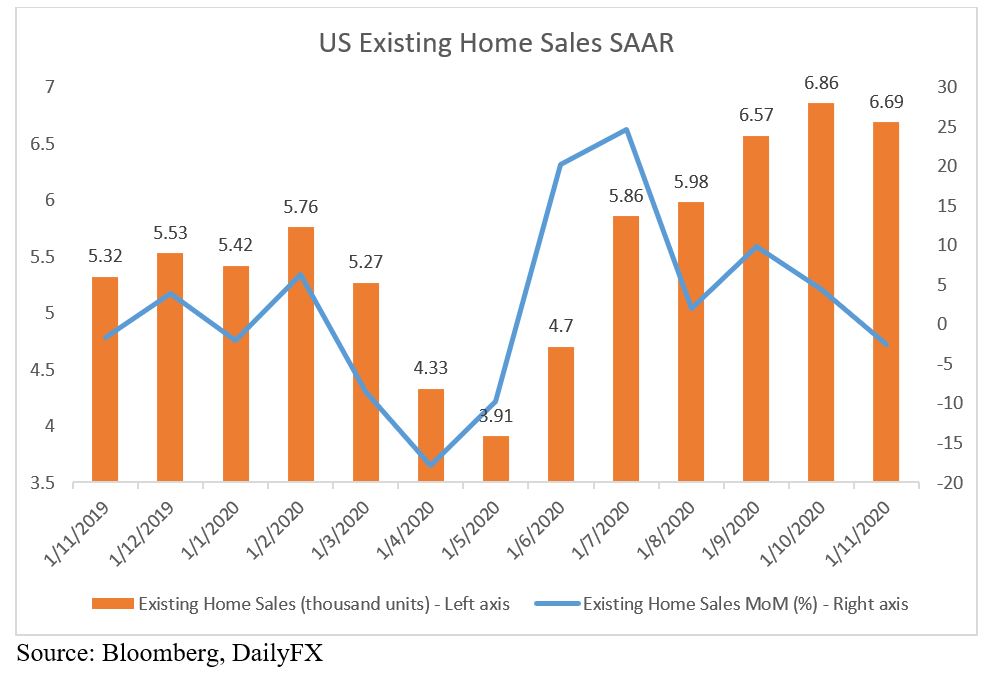
On the macro front, US existing home sales figures came in at 6.69 million, or -2.5% MoM. This marks the first MoM decline observed since May 2020 as a result of soaring house prices and constrains in supply. The US economy expanded at annualized rate of 33.4% QoQ in the third quarter, slightly higher than baseline forecast of 33.1%. Today, the US Core PCE price index, durable goods orders and Michigan consumer sentiment index are among the top events to watch for. Read more on DailyFX calendar.


US Existing Home Sales MoM (November)

US Existing Home Sales MoM (November)

Source: Bloomberg, DailyFX

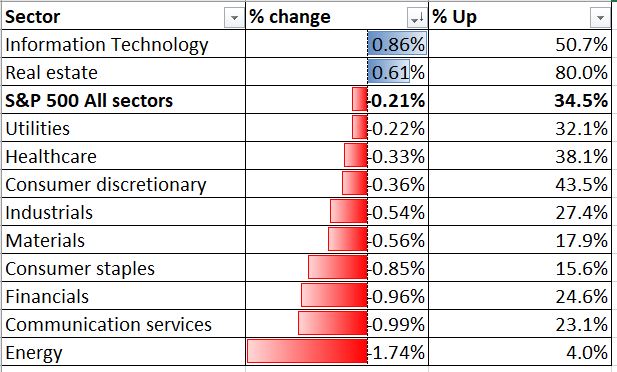
Sector-wise, 9 out of 11 S&P 500 sectors ended lower, with 65.5% of the index’s constituents closing in the red on Tuesday. Energy (-1.74%), communication services (-0.99%) and financials (-0.96%) were among the laggards, while information technology (+0.86%) and real estate (+0.61%) outperformed.

S&P 500 Sector Performance 22-12-2020


S&P 500 Sector Performance 22-12-2020

Source: Bloomberg, DailyFX

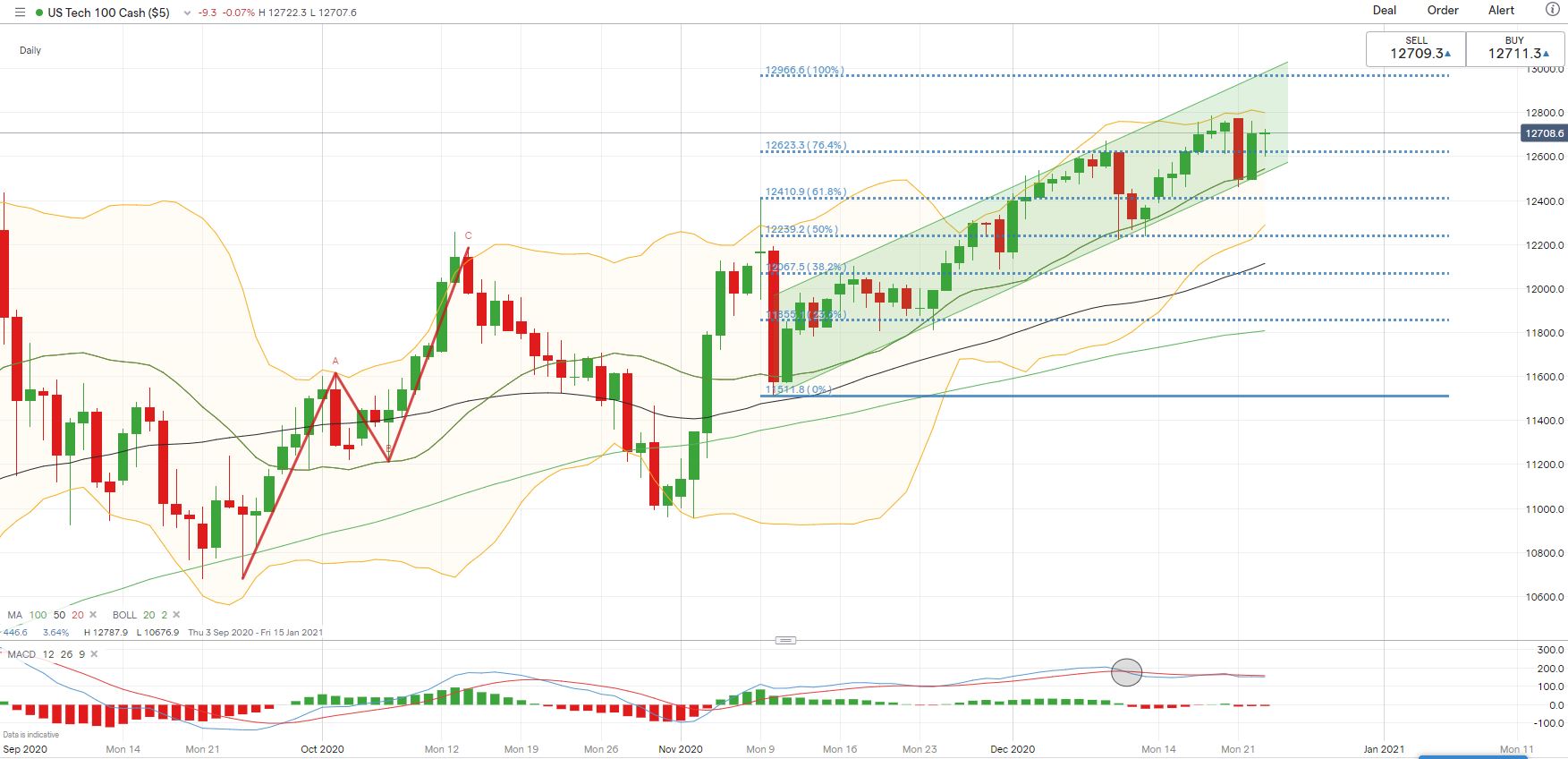
Nasdaq 100 Index Technical Analysis

The Nasdaq 100 index is trending up within the “Ascending Channel” formed since early November, forming higher highs. The overall trend remains bullish-biased, as suggested by upward-sloped 20-, 50- and 100-Day Simple Moving Average (SMA) lines. Its upward momentum, however, appears to be faltering as the MACD indicator trends lower after the formation of a “Death Cross” in early December. Immediate support and resistance levels can be found at 12,530 and 12,790 respectively.

Nasdaq 100 Index  Daily Chart

Nasdaq 100 Index – Daily Chart


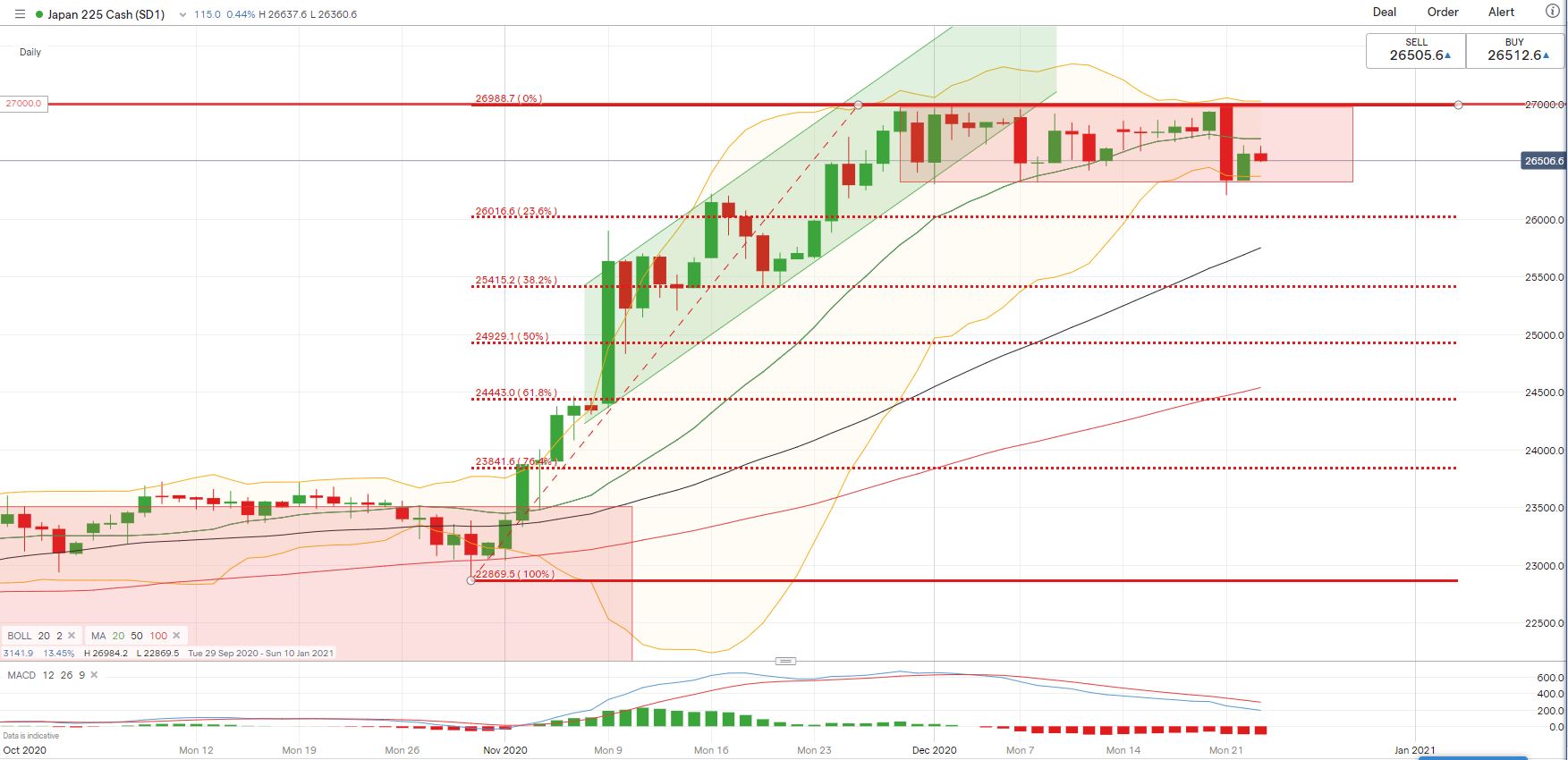
Nikkei 225 Index Technical Analysis:

The Nikkei 225 index has been trading in a “range-bound” condition since early December as highlighted in red color below. Immediate support and resistance levels can be found at 26,350 and 27,000 respectively. Breaking this support may open the door for further losses with an eye on 26,000 for support.

Nikkei 225 Index  Daily Chart

Nikkei 225 Index – Daily Chart

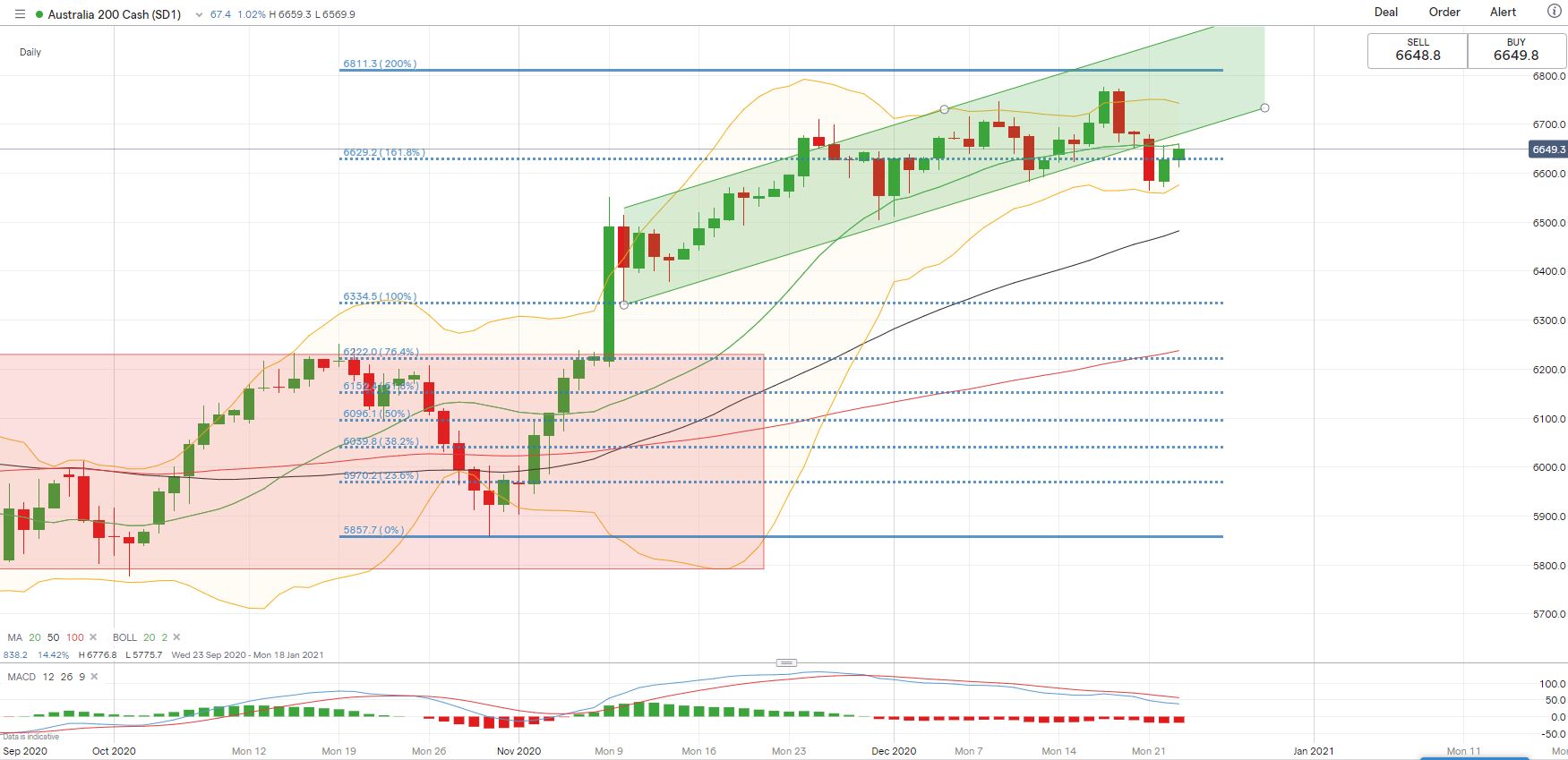
ASX 200 Index Technical Analysis:

The ASX 200 index has likely broken the “Ascending Channel” this week (chart below) and the overall momentum has turned bearish as suggested by the MACD indicator. An immediate support level can be found at 6,570 – the lower Bollinger Band. Price has pierced below the middle Bollinger Band (also the 20-Day SMA), suggesting that near-term trend has likely turned bearish.

ASX 200 Index – Daily Chart

ASX 200 Index – Daily Chart

--- Written by Margaret Yang, Strategist for DailyFX.com